A lithium battery for inverter backup is a LiFePO4 battery that replaces the lead acid or tubular battery behind a home UPS or solar inverter. It gives more usable energy, charges faster, weighs about a third as much and lasts several times longer.
This guide shows how to work out backup time, how lithium compares with a tubular battery, how to size one and how to check it will work with your inverter.
Why Use a Lithium Battery for Inverter Backup?
A lithium battery for inverter use lets you take most of its stored energy every day without harming it. A lead acid battery, by contrast, should normally be discharged only to about half its capacity.
That one difference changes everything else. You get more backup from the same rating, a smaller and lighter battery, and many more years of service.
Lithium vs tubular battery at a glance
| Factor | 12V 150Ah tubular lead acid | 12V 200Ah LiFePO4 |
|---|---|---|
| Stored energy | 1.8 kWh at the 20 hour rate | 2.56 kWh |
| Usable energy for daily cycling | About 0.9 kWh at 50% depth of discharge | About 2.4 kWh at 95% usable |
| Weight | About 54 kg to 55 kg | About 21 kg |
| Rated cycle life | About 1,100 cycles at 80% depth of discharge (one maker’s rating) | 4,000+ cycles (Synergy rating) |
| Maintenance | Water top ups for flooded types | None |
Tubular weights and cycle rating come from published 150Ah datasheets, including Fronus and PCE Power. The lithium figures are for our own 12V 200Ah LiFePO4 battery.
Lead acid loses capacity under heavy load
A lead acid battery’s Ah rating is measured at a slow 10 or 20 hour discharge. At a faster rate it delivers far less: one 150Ah VRLA datasheet lists only 93Ah at a 1 hour rate.
LiFePO4 holds its capacity much better at high current. So when you run a fridge, fans and lights together, the real gap between the two is wider than the label suggests.
How to Calculate Inverter Backup Time
Use this formula for any battery type. Backup time in hours = battery Ah × battery voltage × usable depth × inverter efficiency ÷ load in watts.
| Battery | Calculation for a 300W load | Backup time |
|---|---|---|
| 12V 150Ah tubular | 150 × 12 × 0.5 × 0.9 ÷ 300 | About 2.7 hours |
| 12V 100Ah LiFePO4 | 100 × 12.8 × 0.95 × 0.9 ÷ 300 | About 3.6 hours |
| 12V 200Ah LiFePO4 | 200 × 12.8 × 0.95 × 0.9 ÷ 300 | About 7.3 hours |
These use 90% inverter efficiency, 50% usable depth for lead acid and 95% for lithium. Check your own inverter’s efficiency, since many quick calculators skip the depth of discharge step and overstate lead acid backup.
Work out your load first
Add the watts of everything that runs during a power cut. A typical load might be three ceiling fans at 75W, five LED lights at 15W, a router at 20W and a TV at 100W, which comes to 420W.
Use the rated wattage on each appliance label where you can. Fans on low speed and inverter ACs draw less than their maximum, so measured use is often lower.
How to Size a Lithium Battery for Your Inverter
Turn the formula around to find the capacity you need. Battery Ah = load in watts × backup hours ÷ (battery voltage × usable depth × inverter efficiency).
For example, a 500W load for 4 hours on a 12V LiFePO4 battery needs 500 × 4 ÷ (12.8 × 0.95 × 0.9), which is about 183Ah. So a 200Ah lithium battery covers it with a little room to spare.
The same job with lead acid at 50% depth needs about 370Ah. That is roughly two and a half 150Ah tubular batteries, at well over 100 kg.
Match the battery voltage to your inverter
The battery voltage must match the inverter’s DC input. Small home UPS units are usually 12V or 24V, while larger hybrid solar inverters usually run on 48V.
| Inverter size | Common battery voltage | Lithium option |
|---|---|---|
| Up to about 1 kVA | 12V | 12.8V LiFePO4, 100Ah to 200Ah |
| About 1.5 kVA to 3 kVA | 24V | 25.6V LiFePO4, 100Ah to 200Ah |
| 3 kVA and above, hybrid solar | 48V | 51.2V LiFePO4, 5 kWh to 10 kWh |
Your inverter’s manual states its exact battery voltage. For larger systems, our 48V lithium battery guide explains why higher voltage needs less current.
Will a Lithium Battery Work With My Inverter?
Most modern inverters work with lithium, but older UPS units may need a settings check. Look for a battery type setting in the menu, often labelled “Li”, “LFP” or “User”.
Charge settings for a 12V LiFePO4 battery
| Setting | Per cell | 12V (4 cell) battery |
|---|---|---|
| Maximum charge voltage | 3.65V | 14.6V |
| Typical bulk or absorption | 3.45V to 3.60V | 13.8V to 14.4V |
| Typical low voltage cutoff | About 2.8V | About 11.2V |
Always use the numbers from your battery’s datasheet, since makers differ. For 24V batteries double these figures, and for 48V multiply by four.
Turn off equalise mode
Many lead acid chargers run a periodic equalise stage at a high voltage. A lithium battery does not need it, and the extra voltage can trip the BMS or stress the cells.
Check the charging current
Lithium accepts a much higher charge current than lead acid, but the inverter must not exceed the battery’s rated charge current. Set the inverter’s maximum charge current to the value on the battery datasheet.
Hybrid solar inverters and communication
Hybrid inverters often read the battery’s state of charge over a CAN or RS485 cable. Ask the battery supplier which inverter brands its BMS protocol supports before you buy.
Is a Lithium Battery for Inverter Use Worth the Price?
A lithium battery costs more upfront than a tubular battery of the same Ah rating. But comparing labels is misleading, because lithium delivers about twice the usable energy per Ah and lasts several times as many cycles.
The fair comparison is cost per usable kWh over the battery’s life. Divide the price by usable kWh, then by rated cycles, and compare the two results using real quotes from your local market.
Lithium also saves space, removes water top ups and charges back faster between power cuts. Those gains matter most where outages are frequent and short.
Safety and Installation Tips
- Use cables and a fuse or DC breaker sized for the battery’s maximum current.
- Keep the battery out of direct sun and away from heat sources.
- Do not mix lithium and lead acid batteries in one bank.
- Do not charge LiFePO4 below 0°C unless it has a built in heater.
- Ask for the UN38.3 report and MSDS for the exact battery model.
Lithium Battery for Inverter Checklist
- Battery voltage matches the inverter’s DC input.
- Capacity sized from your load and backup hours with the formula above.
- Inverter has a lithium or user setting, with equalise turned off.
- Charge current set within the battery’s rating.
- BMS continuous current covers the inverter’s full load.
- Communication protocol confirmed for hybrid inverters.
Where Synergy Technology Fits
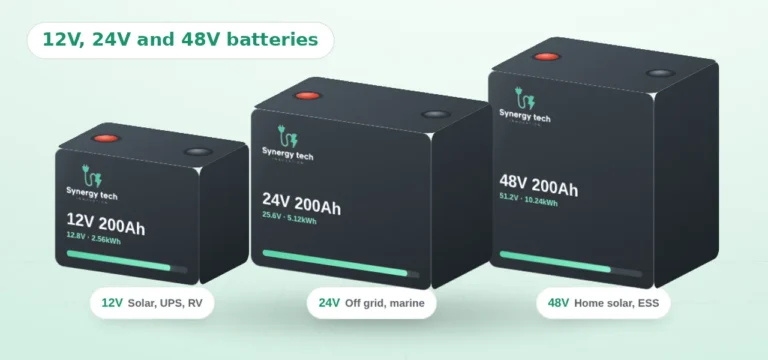
We build LiFePO4 batteries in 12V, 24V and 48V for inverter and solar backup. Our 200Ah lithium battery comes in all three voltages, from 2.56 kWh to 10.24 kWh, with a smart BMS.
Every battery uses Grade A cells, is rated for 4,000+ cycles and ships with CE, UN38.3 and MSDS documents. We will confirm the charge settings for your inverter before you order, but still check your inverter manual yourself.
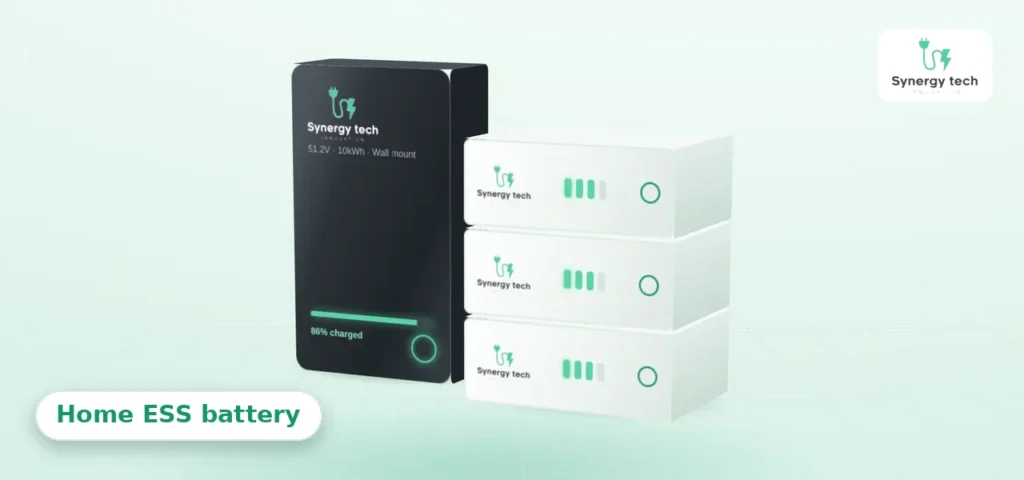
For a whole home system, read our guide to ESS batteries, or see how a solar battery 200Ah fits a solar setup.
Sources and Methodology
Tubular battery weights come from Fronus and PCE Power 150Ah datasheets, and the 1,100 cycle rating is PCE Power’s figure at 80% depth of discharge. The 93Ah at 1 hour figure is from FirstPower’s LFP12150 VRLA datasheet.
The backup formula matches those published by Genus, Livguard and Renogy, with a depth of discharge step added. The 50% depth for lead acid is a common design rule, not a hard limit, and exact cycle curves vary by battery.
All backup and sizing figures are our own arithmetic with the stated assumptions. Synergy figures come from our own product pages and can change.
Need a price for your country?
Factory-direct pricing, shipping to 25+ countries, reply within 24 hours.
Frequently Asked Questions
Click on a question to see the answer
Can I use a lithium battery with my old inverter?
Usually yes, if the battery voltage matches and the inverter lets you set lithium or custom charge voltages. Turn off equalise mode, because lithium does not need it.
How long will a 200Ah lithium battery run my inverter?
A 12V 200Ah LiFePO4 battery runs a 300W load for about 7.3 hours, assuming 95% usable energy and a 90% efficient inverter. Double the load and the time roughly halves.
Is a lithium battery better than a tubular battery for an inverter?
For daily use, yes. Lithium gives about twice the usable energy per Ah, weighs about a third as much, needs no water and lasts several times more cycles.
What size lithium battery do I need for my inverter?
Multiply your load in watts by the backup hours, then divide by battery voltage × 0.95 × 0.9. A 500W load for 4 hours on 12V needs about 183Ah, so a 200Ah battery fits.
What charge voltage should I set for a 12V lithium battery?
Typical bulk settings are 13.8V to 14.4V, and the maximum is 14.6V. Always use the figures on your battery's datasheet.
Can I mix lithium and lead acid batteries on one inverter?
No. They need different charge voltages and discharge differently, so one would be overcharged or underused.
How long does a lithium inverter battery last?
A good LiFePO4 battery is rated for thousands of cycles. Synergy Technology rates its batteries for 4,000+ cycles, which is over 10 years at one cycle a day.
Why does my tubular battery give less backup than the formula?
Lead acid capacity is rated at a slow discharge, and a heavy load drains it faster than the label suggests. One 150Ah VRLA datasheet lists only 93Ah at a 1 hour rate.
Does a lithium battery need maintenance?
No water top ups or equalise charges are needed. Keep it cool, use the right charge settings and check the connections once in a while.
Which voltage lithium battery do I need for a 5 kVA solar inverter?
Most 5 kVA hybrid solar inverters use a 48V battery. Check the inverter manual, then choose a 51.2V LiFePO4 battery of about 5 kWh to 10 kWh.