ESS batteries are the battery packs inside an energy storage system: they store electricity when it is cheap or plentiful and release it when you need it. Most ESS batteries sold today use lithium iron phosphate (LiFePO4) cells, controlled by a battery management system.
This guide covers what an ESS is made of, the sizes it comes in, how to read its specs, how to size one and which safety standards matter.
What Are ESS Batteries?
ESS batteries are rechargeable batteries designed for stationary energy storage rather than for vehicles or phones. They sit in a home, shop, factory or solar farm and cycle every day, often for ten years or more.
ESS stands for energy storage system. When people say “ESS battery” they usually mean the whole cabinet or wall unit, not just the cells inside it.
Why LiFePO4 became the standard chemistry
Two lithium chemistries dominate: lithium iron phosphate (LFP) and nickel manganese cobalt (NMC). NREL’s Annual Technology Baseline notes that LFP became the primary chemistry for stationary storage starting in 2022.
LFP gives up some energy density, but that matters little for a battery that never moves. In return it offers a more stable chemistry and a longer cycle life.
What Is Inside an Energy Storage System?
An ESS is more than a big battery. Instead, it is a set of parts that each do one job, and a weak part limits the whole system.
| Part | What it does | What to check |
|---|---|---|
| Battery cells and modules | Store the energy as chemical charge | Cell chemistry, grade and maker |
| Battery management system (BMS) | Protects cells from overcharge, deep discharge, heat and imbalance | Current rating and communication with the inverter |
| Power conversion system (PCS) or inverter | Converts DC battery power to AC and back | Power rating in kW and efficiency |
| Energy management system (EMS) | Decides when to charge and discharge | Scheduling, solar and grid settings |
| Thermal management | Keeps cells in their safe temperature range with air or liquid cooling | Rated operating temperature |
| Enclosure and fire protection | Houses the system and limits damage if a fault happens | IP rating, detection and suppression |
The BMS and the EMS are often confused. The BMS protects the battery, while the EMS decides how the battery is used.
Types of ESS Batteries by Size
ESS batteries come in three broad size classes. The class decides the voltage, the cooling method and the standards that apply.
| Class | Typical energy | Common format | Typical user |
|---|---|---|---|
| Residential | 5 kWh to 20 kWh | Wall mounted or stacked 48V modules | Homes with solar or frequent power cuts |
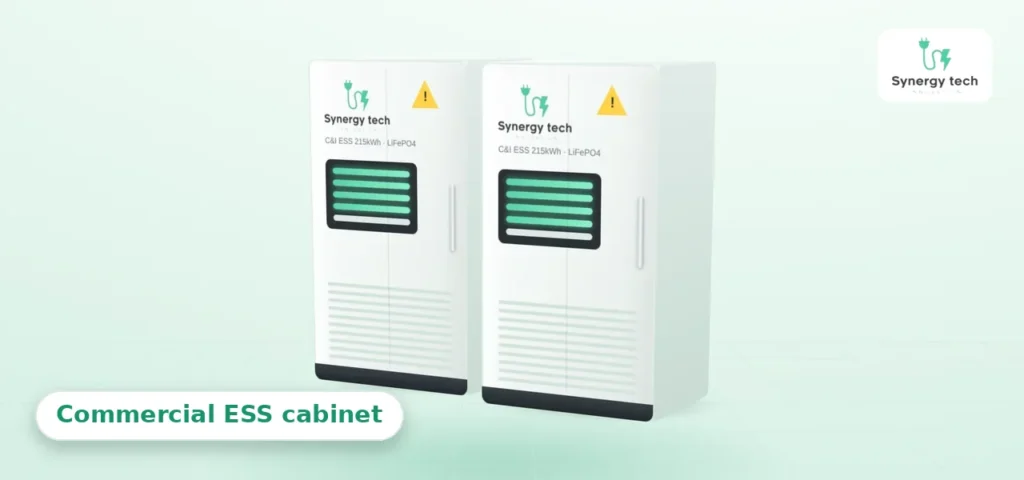
| Commercial and industrial | 30 kWh to 500 kWh | Floor cabinets, high voltage racks | Shops, offices, factories, farms |
| Utility scale | Megawatt hours | Shipping container systems | Grid operators and solar parks |
Low voltage and high voltage systems
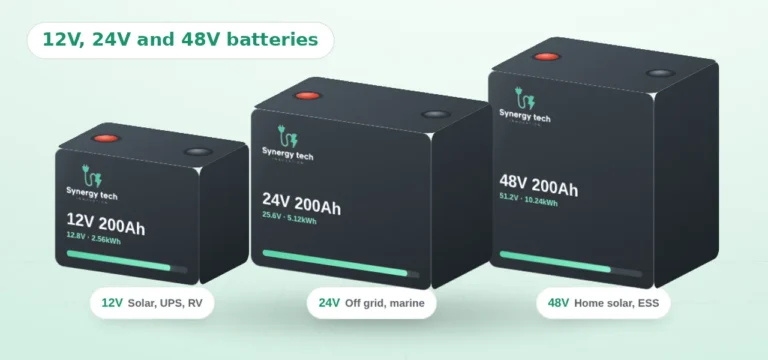
Most home ESS batteries run at a nominal 51.2V, built from 48V class modules. Our 48V lithium battery guide explains that voltage in detail.
Larger cabinets connect many modules in series to reach several hundred volts. As a result, higher voltage lets the system move more power with less current.
How to Read ESS Battery Specs
kWh is energy, kW is power
Kilowatt hours (kWh) tell you how much energy the battery holds. Kilowatts (kW), on the other hand, tell you how fast it can deliver that energy.
Divide kWh by kW to get the duration at full power. A 10 kWh battery with a 5 kW inverter can supply full power for about 2 hours.
Usable capacity
Some makers list total capacity and others list usable capacity. So always ask for usable kWh, because that is what actually reaches your loads.
Round trip efficiency
Round trip efficiency is the share of energy you get back out after charging the battery. According to US Energy Information Administration data, the US utility scale battery fleet averaged a monthly round trip efficiency of 82% in 2019.
That figure includes inverter and auxiliary losses at real sites. A battery datasheet may quote a higher figure measured at the cell or DC level, so check what is included.
Cycle life and warranty
Cycle life is how many full charge and discharge cycles the battery delivers before its capacity falls to a set level, often 70% or 80%. A cycle number only means something when you know the depth of discharge and temperature behind it.
What Do ESS Batteries Do?
Backup during power cuts
The battery takes over when the grid fails, so lights, internet, fridges and machines keep running. For homes, this is the main reason to buy one.
Storing solar power for the evening
Solar panels produce the most around midday, while most homes use the most in the evening. The battery stores the midday surplus so you use your own solar at night.
Cutting peak demand charges
Many commercial tariffs charge for the highest power drawn in a billing period. In that case, an ESS can discharge during those peaks, so the meter sees a lower maximum.
Shifting to cheaper hours
Where electricity costs less at night, the battery charges then and discharges in the expensive daytime hours. Savings depend entirely on your local tariff.
How to Size ESS Batteries
1. List what must keep running
Write down each load and its watts. Then estimate how many hours it runs during an outage or each evening.
2. Find your daily energy need
Multiply watts by hours for each load and add them up. A fridge at 150W for 24 hours, lights at 200W for 6 hours and a router at 20W for 24 hours come to 3.6 + 1.2 + 0.48 = 5.28 kWh.
3. Add losses and headroom
Divide by the round trip efficiency, then add a margin so the battery is not emptied every day. With 90% efficiency and 20% headroom, 5.28 kWh becomes about 7 kWh.
4. Check the power rating
Add up the loads that may run at the same time, including motor start surges. The inverter and the BMS must both handle that peak.
5. Plan for growth
Choose a system that lets you add modules later, because a stackable design costs less than replacing the whole battery when your needs grow.
LFP vs NMC for Energy Storage
| Factor | LFP (LiFePO4) | NMC |
|---|---|---|
| Energy density | Lower | Higher |
| Thermal stability | Higher | Lower |
| Cobalt and nickel | None | Contains both |
| Main use today | Stationary storage | Electric vehicles, where weight matters |
For a battery that stays in one place, weight and size rarely decide the choice. That is why stationary storage moved to LFP.
Safety Standards for ESS Batteries
Standards are how you tell a tested product from a well photographed one. Still, the right list depends on your country and the size of the system.
| Standard | What it covers |
|---|---|
| UN38.3 | Transport safety tests required before lithium batteries can ship |
| IEC 62619 | Safety of lithium cells and batteries in industrial and stationary use |
| UL 9540 | Safety of the complete energy storage system, including battery, power conversion and controls |
| UL 9540A | A test method for how thermal runaway fire spreads in a battery system |
| NFPA 855 | Installation rules for stationary energy storage in the United States |
UL 9540 tests the integrated system, not just the cells. Many US codes require ESS to be listed to it, while other markets often ask for IEC 62619 instead.
Ask for each report with your exact model number on it. A certificate for a different model or for the cells alone does not cover the finished system.
ESS Batteries Buying Checklist
- Usable kWh, not just total kWh.
- Continuous and peak kW, matched to your inverter.
- Cell chemistry and grade, with the cell maker named.
- Cycle life with its depth of discharge and end of life capacity stated.
- BMS communication protocol supported by your inverter brand.
- Operating temperature range for your climate.
- UN38.3, IEC 62619 and MSDS for the exact model.
- Option to add modules later.
Where Synergy Technology Fits
We build LiFePO4 ESS batteries in our Shenzhen factory, from 5 kWh home units to 500 kWh commercial systems. Every unit uses Grade A cells and a smart BMS, and is rated for 4,000+ cycles.
For factories and larger sites, see our industrial and commercial ESS from 30 kWh to 500 kWh.
We ship to buyers in more than 25 countries with CE, IEC, UN38.3 and MSDS documents. We also size systems for free, but the steps above still apply to any supplier you consider.
To understand the cells inside these systems, read our guide to lithium battery cells.
Sources and Methodology
The chemistry trend comes from NREL’s 2024 Annual Technology Baseline for utility scale battery storage. The 82% round trip efficiency figure is US Energy Information Administration fleet data for 2019, as reported by CleanTechnica.
The component list was checked against Energy Toolbase, ACCURE and Benchmark Minerals explainers. Standard scopes come from the UL 9540 scope text published by ANSI and the Standards Council of Canada, and from the IEC catalogue for IEC 62619.
The sizing example is our own arithmetic with stated assumptions. Synergy product ranges come from our own product pages and can change.
Need a price for your country?
Factory-direct pricing, shipping to 25+ countries, reply within 24 hours.
Frequently Asked Questions
Click on a question to see the answer
What does ESS stand for in batteries?
ESS stands for energy storage system. ESS batteries are the battery packs inside that system, built to store electricity in one place and cycle every day.
What is the difference between an ESS battery and a normal battery?
An ESS battery is designed for stationary daily cycling over many years, with a BMS that talks to an inverter. A normal starter or backup battery is built for short bursts or occasional use.
Which chemistry is best for ESS batteries?
Lithium iron phosphate (LiFePO4) is the standard for stationary storage. It is more thermally stable and lasts more cycles than NMC, and its lower energy density matters little for a battery that does not move.
How many kWh ESS battery do I need for my home?
Add up the watt hours of the loads you want to run, divide by about 0.9 for losses and add 20% headroom. Many homes land between 5 kWh and 15 kWh.
What is the difference between kW and kWh on an ESS battery?
kWh is how much energy the battery stores. kW is how fast it can deliver that energy, which decides how many appliances can run at once.
How efficient are ESS batteries?
US utility scale battery systems averaged an 82% monthly round trip efficiency in 2019, according to EIA data. Datasheets often quote higher figures measured before inverter losses.
How long do ESS batteries last?
A good LiFePO4 ESS battery is rated for several thousand cycles. Synergy Technology rates its ESS batteries for 4,000+ cycles, which is over 10 years at one cycle a day.
What is the difference between a BMS and an EMS?
The battery management system protects the cells from overcharge, deep discharge and heat. The energy management system decides when the battery charges and discharges.
Which certificates should an ESS battery have?
Ask for UN38.3 for shipping, IEC 62619 for stationary safety and an MSDS. In the United States, look for a UL 9540 listing for the complete system.
Can I add more ESS batteries later?
Yes, if the system is stackable and the new modules match the existing ones. Check with the maker before buying, because mixing models or ages can limit capacity.