
Lithium battery cells are the single units that store energy inside every lithium battery pack, from a phone to a 500 kWh storage cabinet. A cell has one positive electrode, one negative electrode, a separator and an electrolyte, and packs are built by wiring many cells together.
This guide explains how a cell works, the main formats and chemistries, how to read a cell datasheet, and how to check quality before you buy.
What Are Lithium Battery Cells?
Lithium battery cells are rechargeable electrochemical units that move lithium ions between two electrodes to store and release electricity. One cell gives a fixed voltage, so batteries combine cells in series for voltage and in parallel for capacity.
A cell is not a battery on its own, so a finished battery adds a battery management system (BMS), wiring, a case and often a heater or cooling.
How a Lithium Cell Works
Every lithium ion cell has four main parts, as Argonne National Laboratory describes them. These are the cathode, the anode, a separator and the electrolyte.
| Part | What it is | What it does |
|---|---|---|
| Cathode (positive) | A lithium metal compound, such as lithium iron phosphate | Holds lithium when the cell is empty |
| Anode (negative) | Usually graphite on copper foil | Holds lithium when the cell is full |
| Separator | A thin porous plastic film | Lets ions pass but stops the electrodes touching |
| Electrolyte | A lithium salt dissolved in a solvent | Carries lithium ions between the electrodes |
Charging and discharging
When you charge a cell, lithium ions leave the cathode, cross the separator and slot between the layers of the graphite anode. This process is called intercalation.
When you use the cell, the ions travel back to the cathode. At the same time, electrons flow through your device, and that flow is the electric current.
The separator matters more than its thickness suggests. If it fails and the electrodes touch, the cell shorts internally, which is why cell quality and BMS protection go together.
Types of Lithium Battery Cells by Format
The same chemistry can be packed into three shapes. In turn, the shape affects pack size, cooling and how many cells you need.
| Format | Common sizes | Strengths | Typical uses |
|---|---|---|---|
| Cylindrical | 18650 (18mm × 65mm), 21700 (21mm × 70mm) | Strong steel can, mature mass production | Power tools, e-bikes, some EVs and small packs |
| Prismatic | 100Ah, 280Ah, 314Ah LiFePO4 | Large capacity, few cells per pack, easy to stack | Home and commercial energy storage |
| Pouch | Varies by maker | Light and flexible in shape | Phones, laptops, some EVs |
The cylindrical size names are simply the dimensions. An 18650 is 18mm wide and 65mm long, and a 21700 is 21mm wide and 70mm long.
Why storage uses large prismatic cells
A 48V pack built from 314Ah prismatic cells needs only 16 cells. Building the same energy from small cylindrical cells takes hundreds, with far more welds and connections that can fail.
Lithium Cell Chemistries Compared
“Lithium” covers several cathode chemistries, and each one trades energy density against safety and life.
| Chemistry | Nominal cell voltage | Main strength | Main use |
|---|---|---|---|
| LiFePO4 (LFP) | 3.2V | Thermal stability and long cycle life | Energy storage, solar, golf carts, buses |
| NMC | About 3.6V to 3.7V | High energy density | Electric cars, e-bikes, tools |
| LCO | About 3.7V | Very high energy density in small cells | Phones and laptops |
| LTO | About 2.4V | Very fast charging and very long life | Special industrial uses |
For stationary storage, LiFePO4 is now the default. It holds less energy per kilo, but that matters little when the battery never moves.
How to Read a Lithium Cell Datasheet
A datasheet tells you far more than the capacity printed on the case. Here is what each key line means, using a widely sold 314Ah LiFePO4 cell, the EVE MB31, as the example.
| Spec | EVE MB31 value | What it tells you |
|---|---|---|
| Nominal voltage | 3.2V | Average voltage during discharge |
| Nominal capacity | 314Ah | Charge stored at the rated test current |
| Energy per cell | About 1,005Wh | 3.2V × 314Ah, the real storage figure |
| Voltage window | 2.5V to 3.65V | Safe operating range; outside it the cell is damaged |
| Continuous current | 0.5C, about 157A | Current the cell can carry all day |
| Cycle life | 8,000 cycles to 70% state of health | Rated life under the maker’s test conditions |
| Weight | About 5.6kg | Affects shipping cost and racking |
What “C rate” means
The C rate expresses current as a share of capacity. For example, for a 314Ah cell, 1C is 314A and 0.5C is 157A.
Storage cells are usually rated around 0.5C continuous. That suits a home battery, but it means you must size the cells to your inverter’s current, not just its energy need.
Read the cycle life conditions
The MB31’s 8,000 cycle figure is measured to 70% state of health. A cell rated “6,000 cycles to 80%” from another maker is not directly comparable, so always read the end point.
How Many Cells Does a Battery Need?
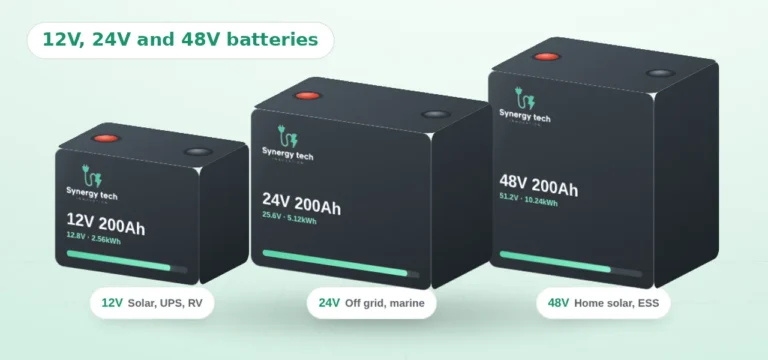
LiFePO4 cells are 3.2V each, so voltage sets the cell count in series. Capacity then comes from the cell size you choose.
| Battery | Cells in series | With 100Ah cells | With 280Ah cells | With 314Ah cells |
|---|---|---|---|---|
| 12V (12.8V) | 4 | 1.28 kWh | 3.58 kWh | 4.02 kWh |
| 24V (25.6V) | 8 | 2.56 kWh | 7.17 kWh | 8.04 kWh |
| 48V (51.2V) | 16 | 5.12 kWh | 14.34 kWh | 16.08 kWh |
These are nominal figures from voltage times capacity. For more on 16 cell packs, see our 48V lithium battery guide.
Grade A vs Grade B Lithium Cells
“Grade A” is the most used and least defined phrase in cell buying. There is no single international standard for it, and each factory sets its own thresholds.
In practice, factories sort cells after production by capacity, internal resistance, self discharge, voltage, size and appearance. Cells that meet the full specification are sold as Grade A, and cells slightly outside it are sold as Grade B at a lower price.
Grade B cells are not always bad. The problem is Grade B sold as Grade A, because the buyer pays for a quality they did not get.
How to check cell quality yourself
- Ask for the factory test data for each cell: capacity, internal resistance and voltage.
- Check that the QR code on each cell matches the supplier’s records and the cell model.
- Run a capacity test on a sample before accepting a large order.
- Check that cells in one pack are matched closely in capacity and internal resistance.
- Look for swelling, dents or reworked terminals.
Matching matters as much as grade. In a series pack, the weakest cell decides when the whole battery stops.
Safety Documents for Lithium Battery Cells
Cells are shipped as dangerous goods, so paperwork is not optional. For that reason, ask for these before you order.
- UN38.3 test report: eight transport tests, from altitude to forced discharge, for the exact cell model.
- MSDS: the safety data sheet freight forwarders and customs require.
- IEC 62619 report: safety testing for cells used in industrial and stationary storage.
Our guide on how to import lithium batteries from China to Pakistan covers the shipping side in more detail.
Lithium Battery Cells Buying Checklist
- Chemistry chosen for the job, with LiFePO4 for storage.
- Energy in Wh per cell, not just Ah.
- Continuous current in C rate, matched to your load.
- Cycle life with its end of life percentage stated.
- Per cell test data for capacity and internal resistance.
- Matched cells for each pack.
- UN38.3, MSDS and IEC 62619 documents for the exact model.
Where Synergy Technology Fits
We supply lithium cells from our Shenzhen base: LiFePO4 prismatic cells in 100Ah, 280Ah and 314Ah, plus 18650 and 21700 cylindrical cells. Every pack we build uses Grade A cells and a smart BMS.
If you would rather buy finished batteries than loose cells, see our LiFePO4 batteries and ESS batteries. We send cell test data and shipping documents with every order, and the checks above still apply to any supplier.
To see how cells come together in a storage system, read our guide to ESS batteries.
Sources and Methodology
The four cell components and the charge and discharge process follow Argonne National Laboratory’s battery explainer, checked against Ossila and EL-CELL technical pages. Cylindrical size names follow their published dimensions.
EVE MB31 figures come from reseller listings that reproduce EVE’s datasheet, cross checked across four sellers. Grading practice is drawn from several cell sellers, who agree there is no single standard; it was not verified with EVE directly.
Pack energy figures are our own arithmetic from nominal voltage and capacity. Synergy product details come from our own product pages and can change.
Need a price for your country?
Factory-direct pricing, shipping to 25+ countries, reply within 24 hours.
Frequently Asked Questions
Click on a question to see the answer
What is the difference between a lithium cell and a lithium battery?
A cell is a single unit with one anode, one cathode and an electrolyte. A battery joins many cells together and adds a BMS, wiring and a case.
What is the voltage of a lithium battery cell?
It depends on the chemistry. A LiFePO4 cell is 3.2V nominal, while NMC and LCO cells are about 3.6V to 3.7V.
Which lithium battery cells are best for solar storage?
LiFePO4 prismatic cells are the usual choice for solar and home storage. They are thermally stable, last thousands of cycles and come in large sizes like 280Ah and 314Ah.
What does 18650 and 21700 mean?
They are cylindrical cell sizes named after their dimensions. An 18650 is 18mm wide and 65mm long, and a 21700 is 21mm wide and 70mm long.
How much energy does a 314Ah LiFePO4 cell store?
About 1,005Wh, which is 3.2V multiplied by 314Ah. Sixteen of them make a 48V pack of about 16 kWh.
How many cells are in a 48V LiFePO4 battery?
Sixteen cells in series. At 3.2V each, they give a nominal 51.2V.
Is there an official standard for Grade A cells?
No. Each factory sets its own grading thresholds for capacity, internal resistance and appearance, so ask for per cell test data instead of relying on the label.
How long do lithium battery cells last?
Large LiFePO4 storage cells are often rated for 6,000 to 8,000 cycles. The EVE MB31, for example, is rated for 8,000 cycles to 70% state of health.
What does C rate mean on a cell?
C rate is current as a share of capacity. For a 314Ah cell, 0.5C is 157A and 1C is 314A.
What documents should come with lithium cells?
Ask for a UN38.3 test report, an MSDS and, for storage use, an IEC 62619 report. Each should name the exact cell model.