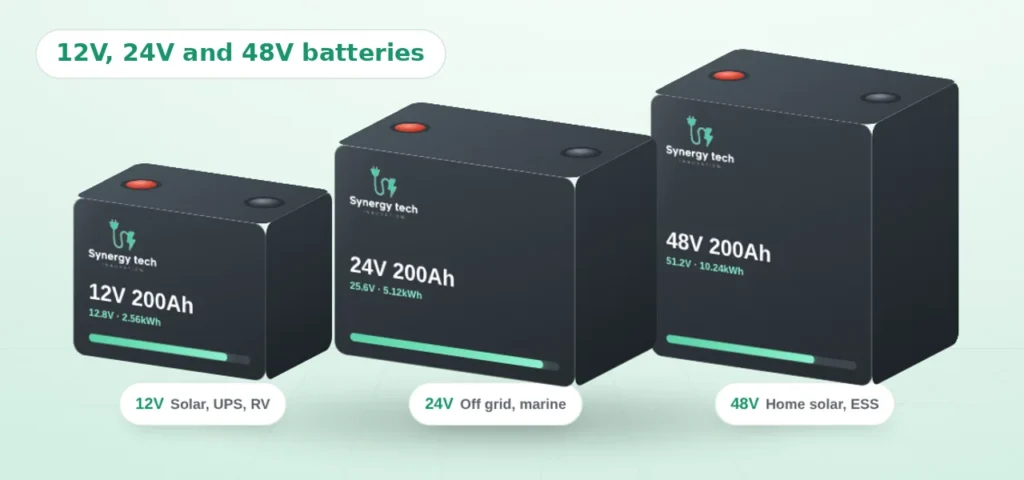
A 48V lithium battery is a battery bank built from 16 lithium iron phosphate (LiFePO4) cells wired in series, giving a nominal voltage of 51.2V. It is the standard size for home solar, inverter backup, golf carts and small energy storage systems.
This guide explains what the “48V” label really means, how to read the capacity, which charge settings to use, and what to check before you buy one.
What Is a 48V Lithium Battery?
A 48V lithium battery is a rechargeable pack whose working voltage sits around 48 to 52 volts, made from lithium cells and controlled by a battery management system (BMS). For solar and backup use, almost every model on the market uses LiFePO4 chemistry.
The BMS is the small circuit board inside the case. It stops the cells from overcharging, over discharging, overheating or shorting, and it keeps the 16 cells balanced.
Why the label says 48V but the spec sheet says 51.2V
Each LiFePO4 cell has a nominal voltage of 3.2V. Sixteen cells in series give 16 × 3.2 = 51.2V, so the “48V” name is a system class, not the exact voltage.
The name comes from older lead acid banks, where four 12V batteries made a 48V system. Lithium packs kept the class name so they fit the same 48V inverters and chargers.
That difference matters when you compare listings. A pack sold as “48V 100Ah” stores 5.12 kWh if it is a true 16 cell LiFePO4 pack, but only 4.8 kWh if the seller calculates at 48V.
How Much Energy Does a 48V Lithium Battery Store?
To find the energy, multiply nominal voltage by amp hours, then divide by 1,000 to get kilowatt hours (kWh). Always compare batteries in kWh, because amp hours alone hide the voltage.
| Battery | Nominal voltage | Capacity | Stored energy |
|---|---|---|---|
| 12V LiFePO4 (4 cells) | 12.8V | 100Ah | 1.28 kWh |
| 24V LiFePO4 (8 cells) | 25.6V | 100Ah | 2.56 kWh |
| 48V LiFePO4 (16 cells) | 51.2V | 100Ah | 5.12 kWh |
| 48V LiFePO4 (16 cells) | 51.2V | 200Ah | 10.24 kWh |
The figures above are simple arithmetic from voltage and capacity. Usable energy is a little lower, because the BMS keeps a small reserve at the top and bottom of the charge.
A quick runtime estimate
Take a 48V 100Ah battery that stores 5.12 kWh. If about 95% of that is usable and your inverter is 90% efficient, you get roughly 5.12 × 0.95 × 0.90 = 4.38 kWh at the plug.
So a steady 1,000W load would run for about 4.4 hours. Check your own inverter’s efficiency on its datasheet, since it changes the answer.
Why Choose 48V Instead of 12V or 24V?
Power equals voltage times current. At a higher voltage the same power needs far less current, and current is what heats cables and wastes energy.
| System | Current needed for a 5,000W load | What it means |
|---|---|---|
| 12V (12.8V nominal) | About 391A | Very thick cables, high heat, large fuses |
| 24V (25.6V nominal) | About 195A | Workable for mid sized systems |
| 48V (51.2V nominal) | About 98A | Normal cable sizes, lower losses |
Cable heat loss rises with the square of current. With the same cable, a 51.2V system loses about one sixteenth of the energy a 12.8V system would lose at the same power.
That is why many home inverters above 3 kW are built for 48V. A 12V bank simply cannot feed them without very heavy wiring.
When 12V or 24V still makes sense
Small loads such as a camper fridge, lights or a boat’s electronics often run directly on 12V. If your appliances and charger are all 12V and your load is light, a 48V bank adds converters you do not need.
48V Lithium Battery Voltage Chart
A LiFePO4 voltage curve is very flat in the middle, so voltage is a rough guide to charge level, not an exact one. Use the BMS reading or a shunt monitor for accurate state of charge.
| Point | Per cell | 16 cell pack |
|---|---|---|
| Maximum charge limit | 3.65V | 58.4V |
| Typical full charge setting | 3.45V to 3.60V | 55.2V to 57.6V |
| Nominal (rated) voltage | 3.2V | 51.2V |
| Common low voltage cutoff | 2.8V | 44.8V |
| Absolute minimum | 2.5V | 40.0V |
The pack values are per cell figures multiplied by 16. Your battery’s own datasheet always takes priority over a general chart.
How to Charge a 48V Lithium Battery
Use a charger or inverter that has a lithium (LiFePO4) profile, or one that lets you set the voltages yourself. A lead acid profile with an equalise stage can push the pack above its safe limit.
Charge settings vary by maker
We compared four published 48V LiFePO4 datasheets. They all stay at or below the 3.65V per cell ceiling, but their recommended full charge settings differ by more than 3V.
| Datasheet | Recommended charge voltage | Stated maximum |
|---|---|---|
| Discover DLP E 48V | 55.2V bulk and absorption, 53.6V float | Not stated on the sheet |
| Flin Energy 16S 100Ah | 56V | 56.8V |
| Rhino 2 (FRHNO 48143 G2) | 55.6V to 57V | 57V |
| Evlithium 51.2V 100Ah | Charge cutoff 58.4V | 58.4V |
The lesson is simple: there is no single correct charge voltage for every 48V lithium battery. Set your charger to the numbers your battery maker publishes, and ask for them in writing before you buy.
Temperature rules
Most 48V LiFePO4 datasheets allow charging only between about 0°C and 45°C to 55°C. Charging below freezing can damage the cells, so a good BMS blocks it.
Discharging is allowed over a wider range, often down to about minus 20°C. In hot climates, keep the battery out of direct sun and give it airflow.
One 48V Battery or Four 12V Batteries in Series?
You can build a 48V bank from four 12V lithium batteries in series. Inside, both use the same LiFePO4 cells, but the BMS design is different.
A single 48V pack has one BMS that watches all 16 cells together. Four separate 12V batteries each have their own BMS, and none of them sees the whole string.
If one 12V battery shuts off, the other three can be left carrying the full system voltage. Only wire 12V batteries in series if their maker states the maximum series count, and use identical, same age batteries.
For a new home or solar system, a purpose built 48V pack is the cleaner choice. It also usually talks to the inverter over CAN or RS485, which series 12V batteries normally cannot do.
Where 48V Lithium Batteries Are Used
Home solar and inverter backup
Many hybrid solar inverters sold for homes run on a 48V battery bus. One 5 kWh to 10 kWh pack covers lights, fans, a fridge and internet during a power cut.
Our guide on choosing a lithium battery for inverter backup goes deeper on sizing.
Energy storage systems
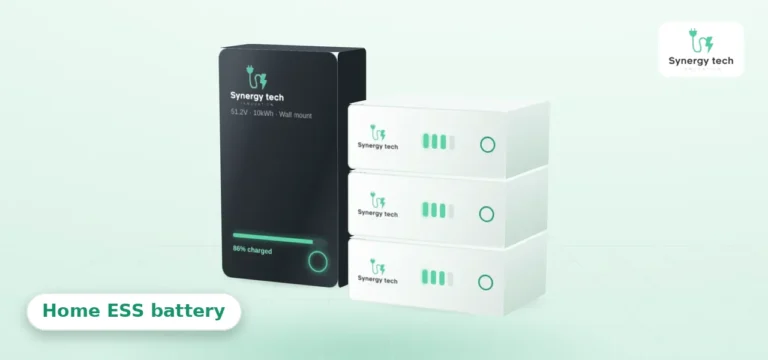
Rack and wall mounted ESS batteries are usually stacks of 48V modules connected in parallel. Adding a module adds capacity without changing the system voltage.
Golf carts, forklifts and other vehicles
Many golf carts and light industrial vehicles use a 48V motor system. IEC 62619 lists golf carts, forklifts and automated guided vehicles among the motive uses it covers.
Telecom and UPS
Telecom sites have used 48V DC power for decades, so 48V lithium packs drop into the same equipment. They replace lead acid with a lighter battery that lasts more cycles.
Safety Standards to Ask For
Certificates tell you a battery was tested by a lab, not just described well in an advert. These are the three documents worth asking any supplier for.
| Document | What it covers | Why you need it |
|---|---|---|
| UN38.3 test report | Eight transport tests, T1 to T8: altitude, thermal, vibration, shock, external short circuit, impact or crush, overcharge and forced discharge | Lithium batteries cannot legally be shipped without it |
| IEC 62619 | Safety tests for lithium cells and batteries in industrial and stationary use, such as energy storage, UPS and telecom | Shows the design was tested for storage use, not just transport |
| MSDS (safety data sheet) | Chemistry, handling, fire response and storage | Required by freight forwarders and customs |
Ask for the actual report with the model number on it. A logo on a product photo proves nothing.
How to Choose the Right 48V Lithium Battery
1. Size it in kWh, not amp hours
Add up the watts of what you want to run and multiply by the hours. Then add about 20% headroom so you do not run the battery flat every day.
2. Match the BMS current to your inverter
Divide the inverter’s maximum power by 51.2 to get the current the battery must deliver. A 5 kW inverter needs a BMS rated for about 100A continuous.
3. Check inverter communication
Ask whether the battery’s BMS protocol works with your inverter brand over CAN or RS485. When they talk to each other, the inverter charges the battery with the right settings automatically.
4. Ask what the cycle rating means
A cycle figure means little without its test conditions. Ask at what depth of discharge and temperature it was measured, and how much capacity remains at the end.
5. Get the charge settings and certificates in writing
Request the datasheet, the UN38.3 report and the MSDS before you pay. A supplier that cannot send them is a risk.
How Long Does a 48V Lithium Battery Last?
A 48V LiFePO4 battery usually lasts several thousand charge cycles, far more than lead acid. Our own 48V LiFePO4 models are rated for 4,000+ cycles, which is over 10 years of one cycle a day.
Lifespan falls faster with heat, constant full charging and very deep daily discharge. Keeping the pack cool and charging to a sensible voltage does more for its life than anything else.
Where Synergy Technology Fits
We build 48V LiFePO4 batteries in our Shenzhen factory with Grade A cells and a smart BMS. The 48V 100Ah LiFePO4 battery stores 5.12 kWh, and the 48V 200Ah model stores 10.24 kWh.
Both ship with CE, UN38.3 and MSDS documents to buyers in more than 25 countries. For larger sites, our ESS batteries scale from 5 kWh to 500 kWh.
No battery removes the rules in this guide. You still need the right charger settings, cable sizes and inverter match, and we will send every datasheet before you order.
48V Lithium Battery Checklist
- Confirm it is a 16 cell LiFePO4 pack with a 51.2V nominal voltage.
- Compare models in kWh, not amp hours.
- Match BMS continuous current to your inverter’s power divided by 51.2.
- Set charge voltages from the battery maker’s datasheet, not a general chart.
- Do not charge below 0°C unless the battery has a heater.
- Ask for the UN38.3 report, IEC 62619 test report and MSDS by model number.
Sources and Methodology
Cell voltages (3.2V nominal, 3.65V maximum, 2.5V minimum) were checked against published LiFePO4 cell and pack datasheets from several makers. The charge setting comparison uses the four datasheets named in the table, read in November 2026.
The UN38.3 test list follows Sub-section 38.3 of the UN Manual of Tests and Criteria, confirmed against Intertek, TÜV SÜD and Kiwa summaries. The IEC 62619 scope comes from the IEC catalogue description of the 2022 edition.
Energy, current and runtime figures are our own arithmetic, shown in the text, not test results. Synergy product figures come from our own product pages, and manufacturers can change their specifications at any time.
Need a price for your country?
Factory-direct pricing, shipping to 25+ countries, reply within 24 hours.
Frequently Asked Questions
Click on a question to see the answer
Is a 48V lithium battery really 48 volts?
Not exactly. A 48V LiFePO4 battery has 16 cells of 3.2V each, so its nominal voltage is 51.2V. The 48V name is the system class it fits.
How many kWh is a 48V 100Ah lithium battery?
A true 16 cell 48V 100Ah LiFePO4 battery stores 5.12 kWh (51.2V × 100Ah). If a seller lists 4.8 kWh, they have calculated at 48V.
What voltage should I charge a 48V lithium battery to?
Use the setting in your battery's datasheet. Published 48V LiFePO4 datasheets recommend between about 55.2V and 58.4V, and none go above 3.65V per cell, which is 58.4V.
What is the low voltage cutoff for a 48V LiFePO4 battery?
A common cutoff is about 44.8V, which is 2.8V per cell. The absolute minimum is around 40V, or 2.5V per cell, but running that low shortens battery life.
How long will a 48V 100Ah battery run my home?
At a steady 1,000W load it runs about 4.4 hours, assuming 95% usable energy and a 90% efficient inverter. Double the capacity or halve the load to double the time.
Can I use a 48V lithium battery with my old lead acid inverter?
Often yes, if the inverter lets you set custom charge voltages or has a lithium profile. Turn off any equalise stage, because it can push a lithium pack past its limit.
Is one 48V battery better than four 12V batteries in series?
For a new system, usually yes. One 48V pack has a single BMS watching all 16 cells, while four 12V batteries each protect only their own cells.
Can I charge a 48V lithium battery in cold weather?
Most LiFePO4 batteries must not be charged below 0°C, because it can damage the cells. Some models include a built in heater that warms the cells before charging.
What certificates should a 48V lithium battery have?
Ask for a UN38.3 test report for shipping, an IEC 62619 report for stationary or industrial use, and an MSDS. Each should name the exact battery model.
How long does a 48V LiFePO4 battery last?
Most are rated for several thousand cycles. Synergy Technology rates its 48V LiFePO4 batteries for 4,000+ cycles, which is over 10 years at one cycle a day.